
Subtotal $0.00
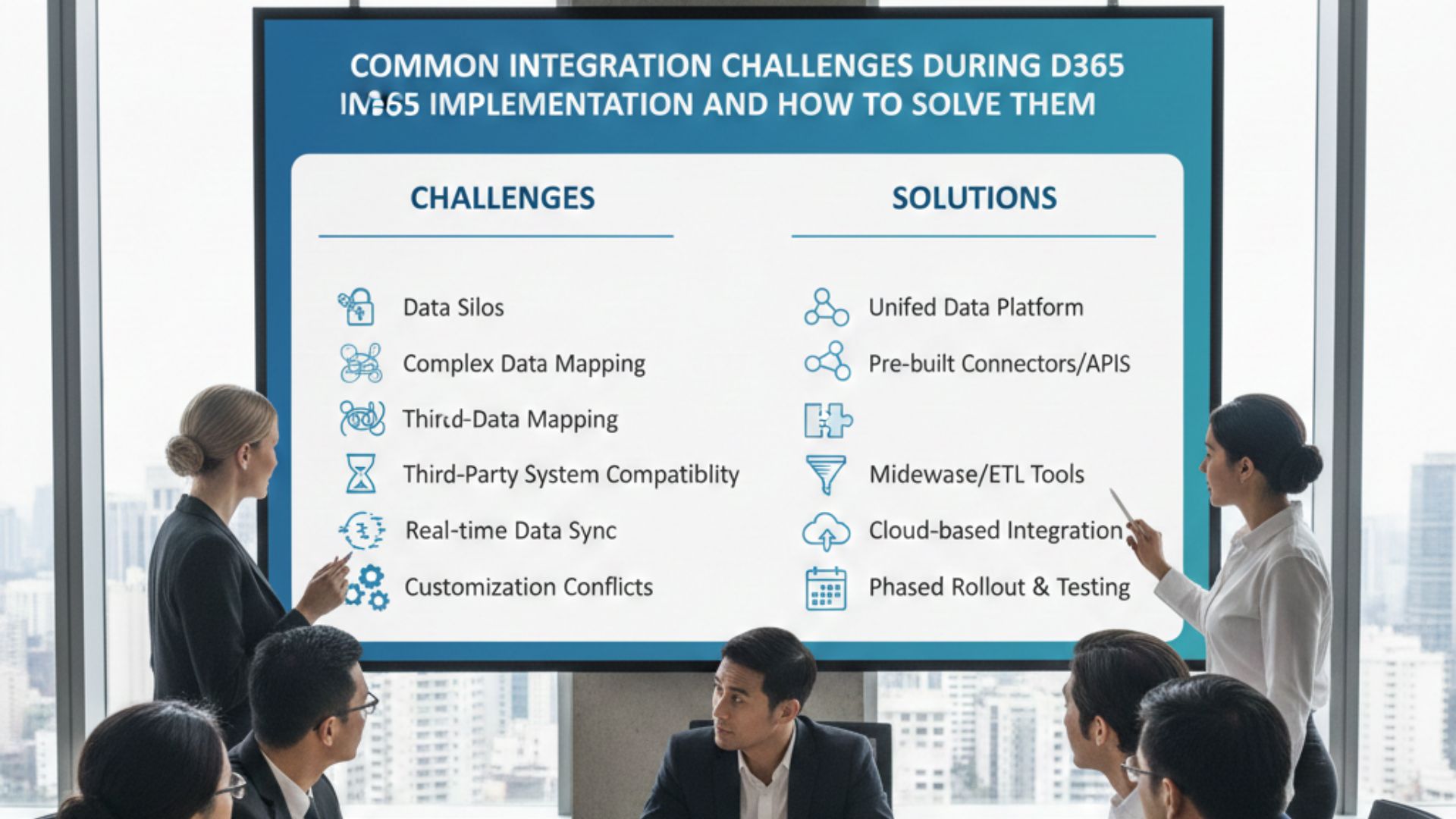
Implementing Microsoft Dynamics 365 is a strategic move for organisations looking to modernise operations, improve visibility, and scale efficiently. However, one of the most complex aspects of any D365 project is system integration. Whether you are deploying Finan ce & Operations, Sales, Customer Service, or Microsoft Dynamics 365 Business Central, integrations can significantly impact project timelines, costs, and long-term success.
For organisations working with a Microsoft Dynamics 365 partner in Manchester UK, understanding common integration challenges—and how to solve them proactively—can make the difference between a smooth go-live and ongoing operational disruptions.
This article explores the most common integration challenges during D365 implementation, practical solutions to overcome them, and best practices followed by experienced MS Dynamics 365 implementation services in Manchester UK. It also includes detailed FAQs to support decision-makers planning ERP or CRM integrations.
Why Integration Is Critical in a D365 Implementation
Businesses across Manchester and the wider UK operate within highly connected digital ecosystems. From manufacturing and distribution hubs in Greater Manchester to professional services firms in the city centre, Microsoft Dynamics 365 integrations are essential for maintaining operational efficiency, regulatory compliance, and scalability.
Microsoft Dynamics 365 rarely operates in isolation. Most businesses rely on multiple systems such as:
- Legacy ERP or accounting systems
- CRM platforms
- E-commerce solutions
- Warehouse Management Systems (WMS)
- Payroll and HR software
- Third-party reporting and BI tools
Successful integration ensures:
- Seamless data flow across systems
- Real-time visibility and reporting
- Reduced manual data entry
- Improved customer and employee experience
However, without the right strategy and expertise from Microsoft Dynamics consulting services in Manchester UK, integration can become a major risk area.
Lack of Integration Strategy and Architecture
The Challenge
One of the most common mistakes during a D365 implementation is starting integrations without a clearly defined strategy. Many organisations:
- Integrate systems on an ad-hoc basis
- Fail to define ownership and governance
- Do not document data flows and dependencies
This often leads to:
- Redundant integrations
- Poor system performance
- High maintenance costs
The Solution
A structured integration strategy should be defined before development begins.
Best practices include:
- Conducting a full application landscape assessment
- Defining integration objectives and priorities
- Choosing the right integration architecture (point-to-point vs middleware)
- Documenting data ownership and update rules
An experienced Microsoft Dynamics 365 partner in Manchester UK will typically design a scalable integration architecture aligned with your long-term digital roadmap.
Data Mapping and Data Quality Issues
The Challenge
Poor data quality is one of the biggest threats to successful D365 integration. Common problems include:
- Inconsistent data formats across systems
- Duplicate or outdated records
- Missing mandatory fields
- Different business rules in legacy systems
These issues are especially common during D365 migration services in Manchester UK, where historical data is integrated or migrated from older platforms.
The Solution
To overcome data-related challenges:
- Perform early data profiling and cleansing
- Standardise data formats and naming conventions
- Define clear master data management (MDM) rules
- Validate data mappings with business users
A phased data migration and integration approach—supported by Microsoft Dynamics 365 Support Services in Manchester UK—reduces risk and improves accuracy.
Integration with Legacy Systems
The Challenge
Many organisations in Manchester still rely on legacy systems that:
- Lack modern APIs
- Use outdated technologies
- Have limited documentation
Integrating these systems with D365 can be technically complex and time-consuming.
The Solution
There are several proven approaches to legacy system integration:
- Use middleware platforms such as Azure Logic Apps or Power Automate
- Expose legacy data via custom APIs or database views
- Replace high-risk integrations with manual or batch processes initially
Experienced MS Dynamics 365 implementation services in Manchester UK often recommend modernising or retiring legacy systems where integration costs outweigh business value.
Real-Time vs Batch Integration Confusion
The Challenge
Not all integrations need to be real-time. Many projects fail because:
- Real-time integrations are overused
- System performance degrades
- Error handling becomes complex
The Solution
Choose the right integration method based on business needs:
- Real-time integrations for customer-facing and operational processes
- Batch integrations for reporting, financial consolidation, and historical data
Clear documentation and decision-making—guided by Microsoft Dynamics consulting services Manchester UK—helps balance performance, cost, and reliability.
Inadequate Error Handling and Monitoring
The Challenge
Many integrations are built without proper error handling. This results in:
- Silent data failures
- Inconsistent records across systems
- Delayed issue detection
The Solution
Robust integration monitoring is essential:
- Implement automated alerts and logs
- Define retry and rollback mechanisms
- Assign ownership for integration failures
Ongoing monitoring is often delivered through Microsoft Dynamics 365 Support Services in Manchester UK, ensuring integrations remain stable post go-live.
Security and Compliance Risks
The Challenge
Integrations often expose sensitive financial, customer, and operational data. Risks include:
- Insecure APIs
- Weak authentication methods
- Non-compliance with GDPR and UK data regulations
The Solution
To mitigate security risks:
- Use Azure Active Directory for authentication
- Encrypt data in transit and at rest
- Apply role-based access controls
- Conduct regular security audits
A trusted Microsoft Dynamics 365 partner in Manchester UK ensures integrations meet enterprise-grade security and compliance standards.
Performance and Scalability Issues
The Challenge
Poorly designed integrations can slow down:
- Microsoft Dynamics 365 Business Central
- External systems
- User experience during peak hours
This becomes a major issue as businesses grow.
The Solution
Performance optimisation strategies include:
- Reducing synchronous calls
- Using message queues for high-volume data
- Load testing integrations before go-live
Scalable integration design is a core focus of professional MS Dynamics 365 implementation services in Manchester UK.
Change Management and User Adoption Challenges
The Challenge
Even technically sound integrations can fail if users:
- Do not trust integrated data
- Continue using old systems
- Bypass automated processes
The Solution
Strong change management ensures integration success:
- Train users on end-to-end processes
- Clearly communicate integration benefits
- Involve business users in testing
Ongoing optimisation supported by Microsoft Dynamics consulting services Manchester UK ensures integrations align with evolving business needs.
Best Practices for Successful D365 Integrations in Manchester, UK
For organisations evaluating MS Dynamics 365 implementation services in Manchester UK, the following best practices are critical for local success:
- Align integration design with UK accounting, VAT, and GDPR requirements
- Ensure Microsoft Dynamics 365 Business Central integrates seamlessly with HMRC-compliant systems
- Use Azure-hosted integration services located in UK or EU data centres
- Work with a Manchester-based Microsoft Dynamics consulting team for faster response times
- Plan long-term support through Microsoft Dynamics 365 Support Services in Manchester UK
These practices directly improve system reliability, audit readiness, and user adoption across UK-based teams.
To summarise, successful integration during D365 implementation requires:
- Early planning and architecture design
- Clean, well-governed data
- Secure and scalable integration tools
- Continuous monitoring and support
Partnering with an experienced Microsoft Dynamics 365 partner in Manchester UK significantly reduces risk and accelerates time to value.
FAQs: D365 Integration Challenges and Solutions
Q 1. What are the most common integration challenges during D365 implementation in Manchester, UK?
Ans: UK businesses commonly face data quality issues, legacy system limitations, unclear integration strategies, GDPR compliance risks, and performance bottlenecks—especially during complex ERP projects delivered across multiple Manchester locations.
The most common challenges include poor data quality, lack of integration strategy, legacy system limitations, performance issues, and inadequate error handling.
Q 2. How does Microsoft Dynamics 365 Business Central in Manchester UK support integrations?
Ans: Microsoft Dynamics 365 Business Central in Manchester UK supports integrations using REST APIs, OData feeds, Power Platform tools, and Azure Logic Apps, enabling secure and scalable connections with local and global business systems.
Microsoft Dynamics 365 Business Central in Manchester UK supports integrations through APIs, web services, Power Platform, and Azure-based middleware, enabling secure and scalable connectivity.
Q 3. Why is middleware important in D365 integrations?
Ans: Middleware simplifies complex integrations, improves scalability, and provides better monitoring and error handling compared to direct point-to-point connections.
Q 4. How can data quality issues affect D365 integrations?
Ans: Poor data quality can lead to inaccurate reporting, system errors, and reduced user trust, especially during D365 migration services in Manchester UK.
Q 5. Should all D365 integrations be real-time for UK businesses?
Ans: No. UK organisations typically use real-time integrations for customer-facing and operational processes, while batch integrations are preferred for financial reporting, VAT submissions, and regulatory data processing.
No. Real-time integrations should be used only where necessary. Batch integrations are often more efficient for reporting and financial processes.
Q 6. How long does it take to build D365 integrations?
Ans: Timelines vary based on complexity, number of systems, and data volume. Experienced MS Dynamics 365 implementation services in Manchester UK can significantly reduce development time.
Q 7. What role does security play in D365 integrations?
Ans: Security is critical. Integrations must comply with GDPR, use secure authentication, and protect sensitive business data.
Q 8. Can legacy systems be integrated with Dynamics 365?
Ans: Yes, but integration complexity depends on the legacy system’s technology. In some cases, modernisation or replacement is more cost-effective.
Q 9. How does post-implementation support help integrations?
Ans: Ongoing support ensures integrations remain stable, secure, and optimised as business processes evolve.
Q 10. Why choose a Microsoft Dynamics 365 partner in Manchester UK for integrations?
Ans: Choosing a Manchester-based Microsoft Dynamics 365 partner ensures local industry expertise, understanding of UK compliance standards, faster on-site or hybrid support, and proven experience delivering D365 integration and migration services across Greater Manchester and the North West.
A local partner offers industry expertise, regulatory knowledge, faster support, and proven integration frameworks tailored to UK businesses.
Conclusion
For organisations across Manchester and the UK, integration challenges during a Dynamics 365 implementation are not just technical—they are strategic. By working with an experienced Microsoft Dynamics 365 partner in Manchester UK, businesses gain access to proven integration frameworks, local regulatory knowledge, and long-term support capabilities.
Whether you are implementing Microsoft Dynamics 365 Business Central in Manchester UK, modernising legacy systems, or planning complex D365 migration services in Manchester UK, a locally focused integration strategy ensures faster ROI, reduced risk, and sustainable digital growth.
With expert Microsoft Dynamics 365 Support Services in Manchester UK, integrations remain secure, scalable, and aligned with evolving UK business requirements.
Integration challenges are inevitable during a Dynamics 365 implementation, but they are entirely manageable with the right strategy, tools, and expertise. By working with a trusted Microsoft Dynamics 365 partner in Manchester UK, organisations can avoid costly pitfalls, ensure seamless data flow, and unlock the full value of Microsoft Dynamics 365 Business Central and related solutions.
With proper planning, strong governance, and ongoing Microsoft Dynamics 365 Support Services in Manchester UK, integrations become a powerful enabler of digital transformation rather than a roadblock.
Comments are closed